
🧑🤝🧑 Syndications
💡 This page is largely for people learning to invest in syndications
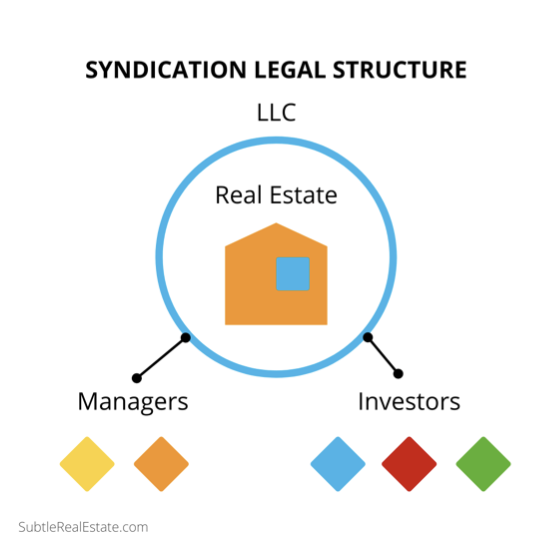
Syndications are a group of people who invest together on a larger project. It is slightly different compared to a JV (joint venture or joint partnership) in that only a handful of the members are actually managing the project while the rest are passive investors.
How the financial structure works
Syndication
- Split based on General Partner (GP) who are the managers of the project and Limited Partners (LP) who are passive
- GPs will be the only ones signing on the loan
- Usually a large 10+ group of people investing in large projects.
- Legal fees are 10-15k+ just to set up because this is a security
Joint Venture
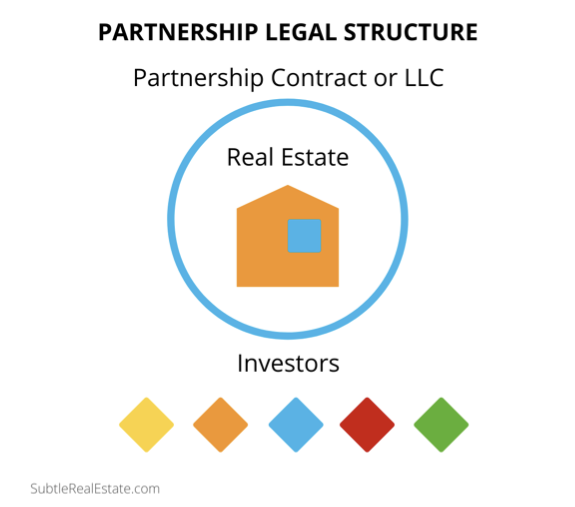
- Everyone is an active participant in the project, if it turns out someone is passive, you could be at risk of committing securities fraud
- Everyone is on the loan
- Maximum is usually 6 people according to both lenders and the SEC, however fractional.app is changing that
- Legal fees <2k depending on complexity
Returns
Preferred Return (6-12%)h
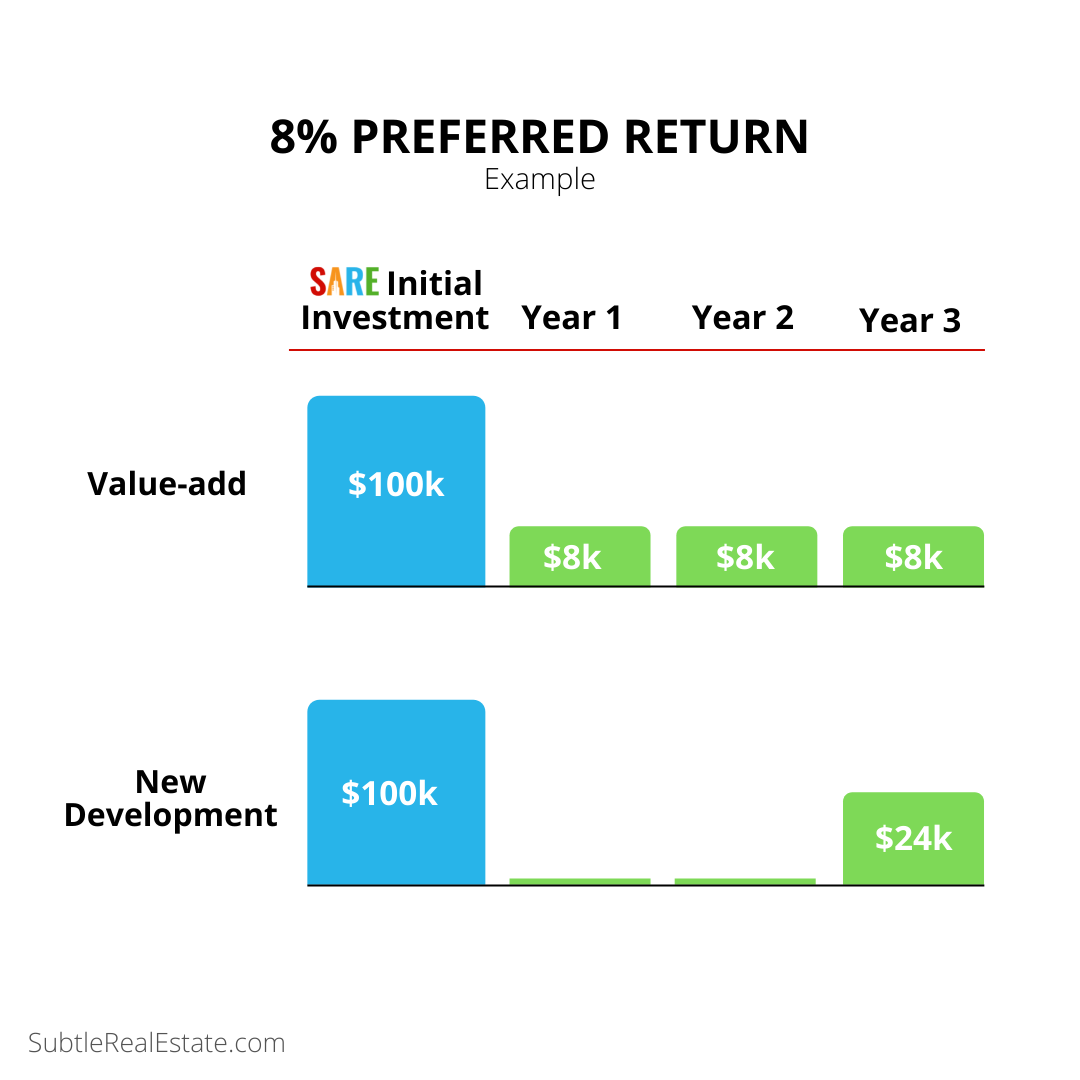
Each year, you will get the first right to the cashflow in the form of a preferred return. This is similar to a simple interest loan, the main difference being that you don’t need to be paid every month like a lender.
Ex. say you invest in a project with 10% preferred return with a 100k investment, you would be owed 10k every year until you got your original capital back.
Equity/Profit Split (usually 30 General Partner/70 Limited Partner)
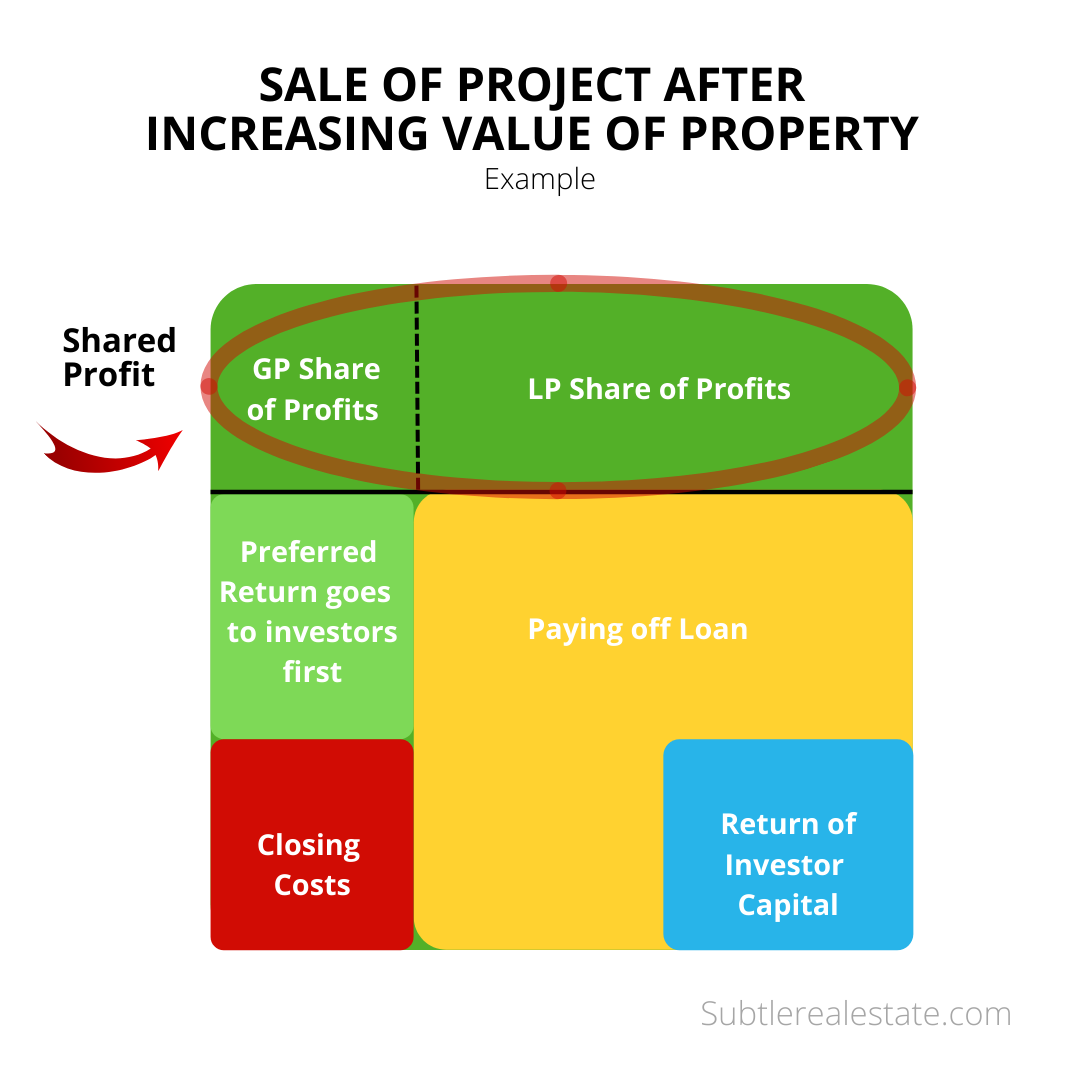
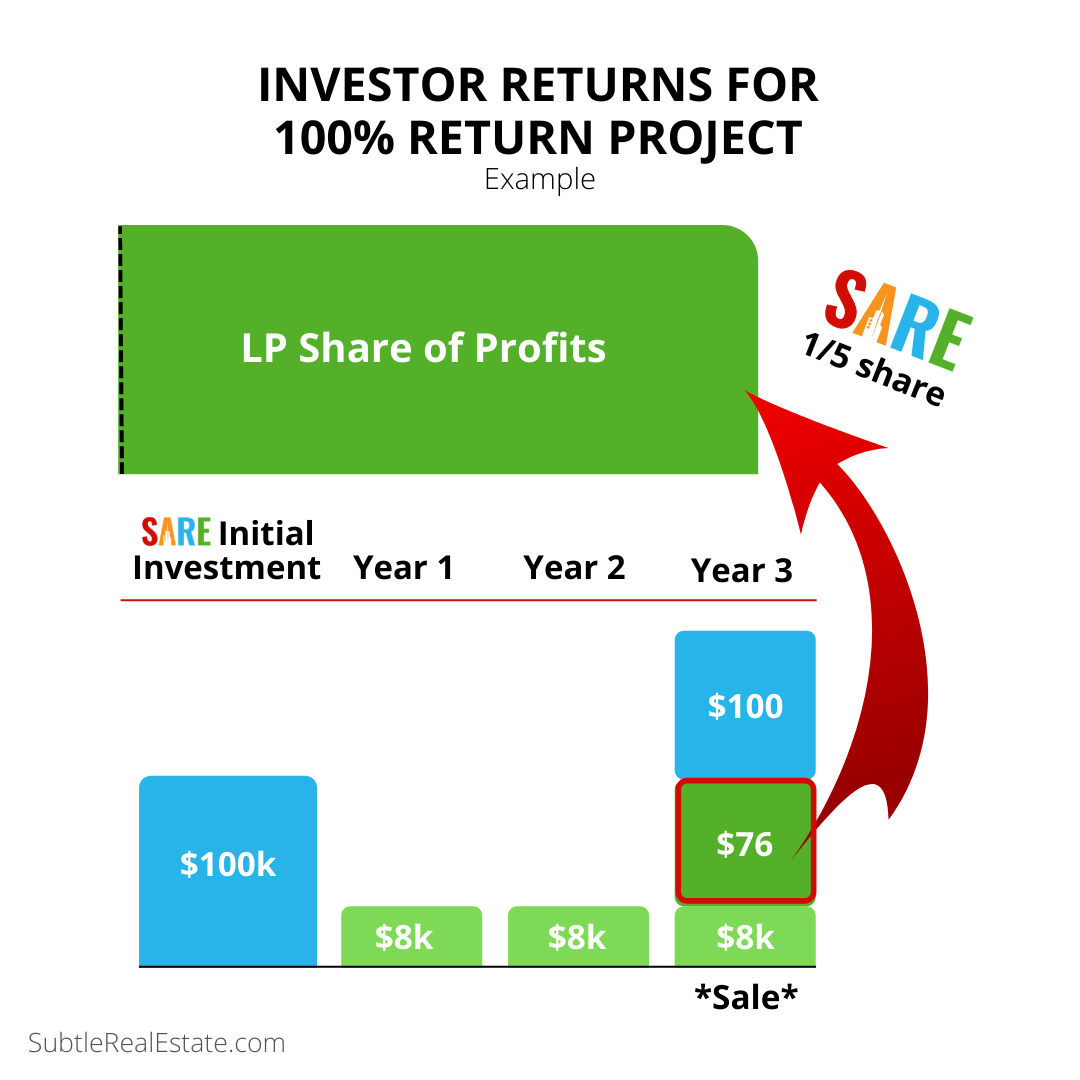
Your equity share is determined by the percentage you invest of the total project.
Ex. The total amount of money needed for the project is $500k. Your 100k investment means you own 1/5 of the 70% equity for capital partners, which means you would own 14% of the property and return for tax purposes.
However, that doesn't mean the General Partners takes 30% of your investment immediately, as the profit is split after preferred return and the return of the equity you invested.
Ex. Say we earned 10k in cashflow for the year based your cut of the investment and want to pay it out. The extra 2k above your 8k in preferred return is split based on the 30/70 equity split.
The same principle applies at the sale - after your original 100k is returned and all debts and preferred returns are paid, we split the profit based on equity.
Cash-on-cash Return (ROI)
COC = Annual cashflow income / Total money down
Does not include sales proceeds only income during operation. The higher this number, the lower the risk that project fails.
If there is a pref (preferred return), make sure that that each year they can pay the pref or at least catch back up in 2-3 years.
Most value-add syndicators will target 8% in cash flowing markets, development projects will not have any as the project will not have income until it is finished building.
Internal Rate of Return (14%+ IRR)
Time has a value. IRR takes discounted cash based on time.
Ex. If you get paid out 10k every year over 5 years, your IRR would be higher than if you were paid a lump sum of 50k at the end of year 5
Fees to watch out for
Acquisition Fees (1-5% of purchase price)
Depending on the size of the discount, there's often quite a bit of work to put together a deal. Paid at closing.
Double check that this number is not higher than the money invested by the syndicator. If they invest only 50k, and charge 50k of fees, it's pretty much like they have no money in the project
Refinance Fees (.5-2% of refinance amount)
The documentation and time required for this is pretty extensive
Disposition (1% of sale price)
The documentation and time required for this is pretty extensive
Property Management Fee (2-8% of revenue)
Depends on the size of the property. Charged only if property manager is in-house
Developer Fee (5-10% of construction budget)
If a syndicator is charging this and hiring out the construction work, most of this fee will end up just going to pay the general contractor. Often included only for more complex construction projects
Asset Management Fee (1-2% of revenue)
Will be charged separately from property management fee. This covers the administrative costs for the syndicator.
🚩 Red Flags For Syndications 🚩
💡 Common Scam #1, No they don't actually own/manage 300 units or $100M
When I started investing as an LP and analyzing deals, I didn't realize this was a marketing trick (apparently illegal one according to our friends at the 506 club). Other syndicators please start calling each other out.
Sponsors/Lead GPs - People who signed on the loan are considered the actual operators of the deal and handle the day to day.
Co-sponsors/Capital Raisers/GPs - Syndicators who raised money but aren't the guarantors on the loan. May or may not be involved in operations. Commercial lenders do NOT consider this experience.
LPs - Limited partners who invest passively and aren't involved in the operations at all.
So for example, we've got around $35M in assets under management that I'm sponsoring. However, there's technically another $75M that I raised money for that I don't actually operate as a co-sponsor because the deal looked great but the sponsor didn't want to split roles on how he operated.
It would be wrong for me to say that I have $110M in assets under management or to add those 300 units to my resume list, since I've only raised $2M of the whole $75M. However, it seems a lot of newer co-sponsoring syndicators didn't get the message so they'll use the whole amount to advertise their actual experience despite being <3% of the entire equity stack. (Technically my portion of it is $6M when accounting for the share of capital I brought because it was 65% LTV)
Also, if you're a newer sponsor don't get suckered into raising money for a sponsor who tells you this counts as experience because this won't help you with future lending at all.
The Deal
Is the property the right price?
- How does cost/unit compare to neighboring properties
- How does rent/unit compare to neighboring properties
- What is the cap rate on the sale? (Purchase cap rate only matters if the property is already stabilized). Not sure what the cap rate is? Google or look at CBRE
What should I look out for in the underwriting?
- No more than 3% rent growth a year. Even if your market got 9% rent growth last year, that’s not sustainable
- No lower than 50% operating expense ratio (although newer properties could operate at lower)
- At least 10% economic vacancy
- Higher exit cap rate than at purchase (generally .1% a year)
- $1500-$2000 cash reserve/unit
Does the person on the sponsor team know all the numbers and terminology?
Throw out some questions about cap rates and loss to lease
How leveraged is this project?
Are they using bridge or agency debt. Bridge debt usually floats to market rates and could really hurt cashflow in an environment where interest rates are increasing.
The Market
You can usually just google these.
Rule of thumb, if you have uber drivers telling you the real estate market is great in a city they aren’t driving in, it might be too late for that market.
The Team
Who is the lead sponsor and what is their performance?
Usually there’s only one person who’s the operator on the deal. Vet based on that sponsors track record. If there’s 8-10 sponsors, that’s not a good sign since there will be too many cooks in the kitchen.
Ask if you can see the financials for the last project. Make sure they got the returns by increasing NOI, not because market cap rate went down and valuations increased.
How long have they been doing real estate?
I generally try to partner with an operator with a decade of experience
Bonus points if they survived 2008-2009, but that also means they likely won’t need your money
Taxes
- You get a K1 as a partner. This can often come in losses in the first year as you’re going to want to take advantage of bonus depreciation
Frequently Asked Questions
What is GP/LP?
GP: General Partner, Sponsor, Managers. Does most of the work/takes on the legal and financial liability of the loan/finds the deal/organizes people and documents/etc
LP: Limited Partner, Capital Partner, Shadow Investor (sounds cooler). Legally has no voting stake in the project, but also your only role is to send the wire transfer at the beginning and receive a check at the end
What is the financial risk?
GP’s are usually paid by taking a higher cut of the profits vs the amount of money they are putting in. However, they stand to lose negative money because the lender with come after them for the difference
LP’s are at risk of losing their investment and going to 0 with their investment.
What is the minimum I need to invest? (Typically 50k)
This number will change depending on the size of the syndicator
How will I see what returns look like?
Most syndicators will provide a complex excel sheet indicating their returns
IRR - Internal Rate of Return. Return accounting for time cost
Profit Splits - how much do sponsors and capital investors get
Equity multiple - how much your initial investment is multiplied by
How much money will sponsors have in the deal?
Typically 10%-20% of the raise for us at subtleassets.com. You want to make sure your GPs are putting their money where their mouth is.
How many other investors will be on the deal?
It’s been 10-15 for our last two projects. Usually you take the full amount and divide it by the minimum (typically 50k) that will tell you the maximum number of other investors.
Do sponsors have Friends and family in these opportunities?
Sponsors should have friends and family investing. This means they aren’t going to likely let it fail since their reputation is on the line.
How do I figure out what is good operating experience?
Usually you want someone that’s gone full cycle on at least on project (sold at least one property) and bonus points if they’ve been around since before the great recession.
How are we compared to other people in market.
The bigger the syndicator, the bigger the slice of pie they take
Sam Kumar (the biggest developer in Austin) takes a 40% equity split but will give better returns than someone coming out of a syndicator bootcamp (Brad Sumrok, Raisemasters, Rod Klief, etc) who will generally only take 18-20% of the upside.
Number of investors in your data base?
My list is about 200 people, so deals will often fill up quickly.
Is this a fund or individual asset?
Individual assets hypothetically have better returns, since less capital is being floated. However, funds can move quicker once good deals come up and don’t need as much money as reserves once spread across more projects.
Taxes?
- Schedule K-1 tax form at the beginning of the year
- Talk to your CPA
Can I 1031 Into a Syndication?
A powerful solution can be 1031-exchanging the sale proceeds of your investment property into a professionally-managed multifamily syndication. This achieves the goal of safely deferring the capital gains taxes, can do it in less time with less stress.
Typically, syndication investors are not direct owners of the property, but rather, owners once-removed (to accommodate the preferred return waterfall). But 1031-exchange investors, in most cases were direct owners of their down leg property (the property being exchanged out of).
To accommodate 1031-exchange investors, the syndication must meet the “like-kind” requirement. This is achieved by setting up a tenants-in-common, (TIC) structure, by which the exchange investor becomes a direct (though fractional) owner of the syndication property, thereby meeting the IRS “like-kind” exchange requirement.
There are other considerations as well. Unlike standard syndications, the TIC structure, employed to accommodate 1031-exchange investors, brings some features that can be challenging in the context of a syndication. One is the TIC feature of “joint and several ownership”, and “shared control”. However, in order to execute a successful syndication, there must be a distinction between investors and management, who are responsible for executing the business plan, making critical decisions, and navigating challenges.
However, these economic and control considerations can be addressed through a side-letter, allowing the syndication to remain compliant with TIC rules, satisfy 1031-exchange requirements, and allow for a successful syndication.
Fast-forward to the successful completion of your new syndication investment: if the syndication sponsor facilitates, you can once again defer your fresh capital gain taxes by 1031-exchanging your interest into yet another syndication. Syndications as a group can 1031-exchange into a succeeding project, but the individual investors cannot exchange their personal interest into something else. Ask your syndication sponsor if they structure 1031 exchanges upon exit.
What type of financing, recourse/non-recourse, rates terms
Changes project to project, often very good in Chicago due to experience and being in a tier 1 city
Frequency of Payouts?
Typically quarterly, depends on the project.
New development and heavy rehab projects take several quarters before actually generating income for distributions.
Why multifamily apartments?
Stability.
Population is growing and supply is limited.
People always need a place to live and rent on average has never collapsed in price.
Why this Value-Add
You’re essentially flipping at a massive scale. It has better returns than just waiting for appreciation.
Deeper value add projects can be BRRR’ed
What are my risk factors
Private placement memorandum (PPM) will list them. To protect yourself, make sure to maximize potential on all three points.
The deal, the market, the team
What is the worst case scenario
Syndicators lose your initial investment, do another call to get more money and then lose that too.
You are not on the hook for the loan, so you won’t lose more than your investment.
How long to hold my money
For most value-add projects.
3 years if refinance, 5-7 for sale
For development projects
3 years to sell from when the project breaks ground (assume land already permitted and zoned)
What happens if I want my invested money for something else
Syndicators can buy you out of your position, often not at market value though. Don’t invest money that you need to survive
How are you finding deals
Brokers + off market
This means mail, text, phone, and etc
How do you target markets?
- Consistent growth in population, jobs, wages, rent, and appreciation
- Neighborhoods in the path of progress
- Landlord-friendly laws
- Suburbs (which historically have outperformed downtowns)
Do I have to submit my financials?
Not for 506b. If you’re required to prove accreditation status, you may have to submit your information to a 3rd party site
Who owns the property legally
The LLC for the property owns the property. Investors then own shares of the LLC
Who manages the property
Changes for each deal. Minimum 200 doors in the market is preferred for a property manager. Too large and then you run into the issue where they don’t give you enough attention.
What if the project fails
We all lose money. We would liquidate the property and pay back investors. Nothing more than the invested capital would be lost for LPs
What do you have in reserves
250-350/unit per year. The amount changes depending on the lender requirements.
Do you guarantee return
Returns are not guaranteed. All investments involve risk and anyone who mentions there’s no risk is lying to you.
Any missed pref return is accrued, but if the project makes no income, that number is still 0 unlike with a loan
What happens if we miss projected cashflow
We would accrue the payout for future distributions and would be taken out of the refinance or sale
Where does my money get sent?
Bank account specific to the property
Minimum investment amount
Depends on the project. Normally 50k
Process after the investment?
Place deal under contract, notify investors of opportunity, offering webinar, explain business plan and specifics, get verbal commitment and then docusign
What do about real estate downturns
- 3 immutable laws. Good deal, good markets, good teams
- If we buy 20% under value then we'd be safe from a correction.
Do you focus on other asset classes
Currently exploring industrial real estate & car washes
Can I invest with an LLC or trust
Yes, the respective tax ID is required in order for us to organize taxes
How is Reporting done
- Recap emails
- Updates
- Occupancy rates, unit renovation updates, details on rental premium, cap ex projects, relevant market updates, resident events
- Financials on quarterly